
Cross-platform mobile development explained
Summary
This article explains cross-platform mobile development in 2026 from a practical, product-first perspective. It defines what cross-platform mobile app development is today, when the approach is effective, and when native development remains a better fit. It outlines four major frameworks – Flutter, React Native, Kotlin Multiplatform, and .NET MAUI – and describes how each works technically and where each brings value.

Eugene Sihai
Head of Mobile Development Department, Modsen
Most discussions around cross-platform mobile application development still rely on familiar arguments – speed, cost, “one codebase for both platforms.” But in practice, the real choice is rarely that simple. It depends on where the product is heading, what risks the business is willing to take, and how clearly both the business side and the engineering side understand the implications behind each path.
That's why this article focuses on cross-platform through that practical lens – not as a shortcut, but as an approach that can support a product’s growth when used deliberately. Ahead, we’ll unpack what cross-platform actually means today, where it creates real value, and where its trade-offs start to matter – helping you decide whether it’s the right direction for your product or your career.
What is cross-platform mobile app development
At its core, cross-platform mobile app development is the approach of building a single mobile application that runs on multiple operating systems – typically iOS and Android –using a shared codebase. Instead of maintaining two separate native apps with different languages, tools, and release cycles, teams work within one unified environment and deliver updates simultaneously across platforms. For many companies, this becomes not just a technical decision but a strategic one: reducing duplication, aligning timelines, and simplifying product evolution.
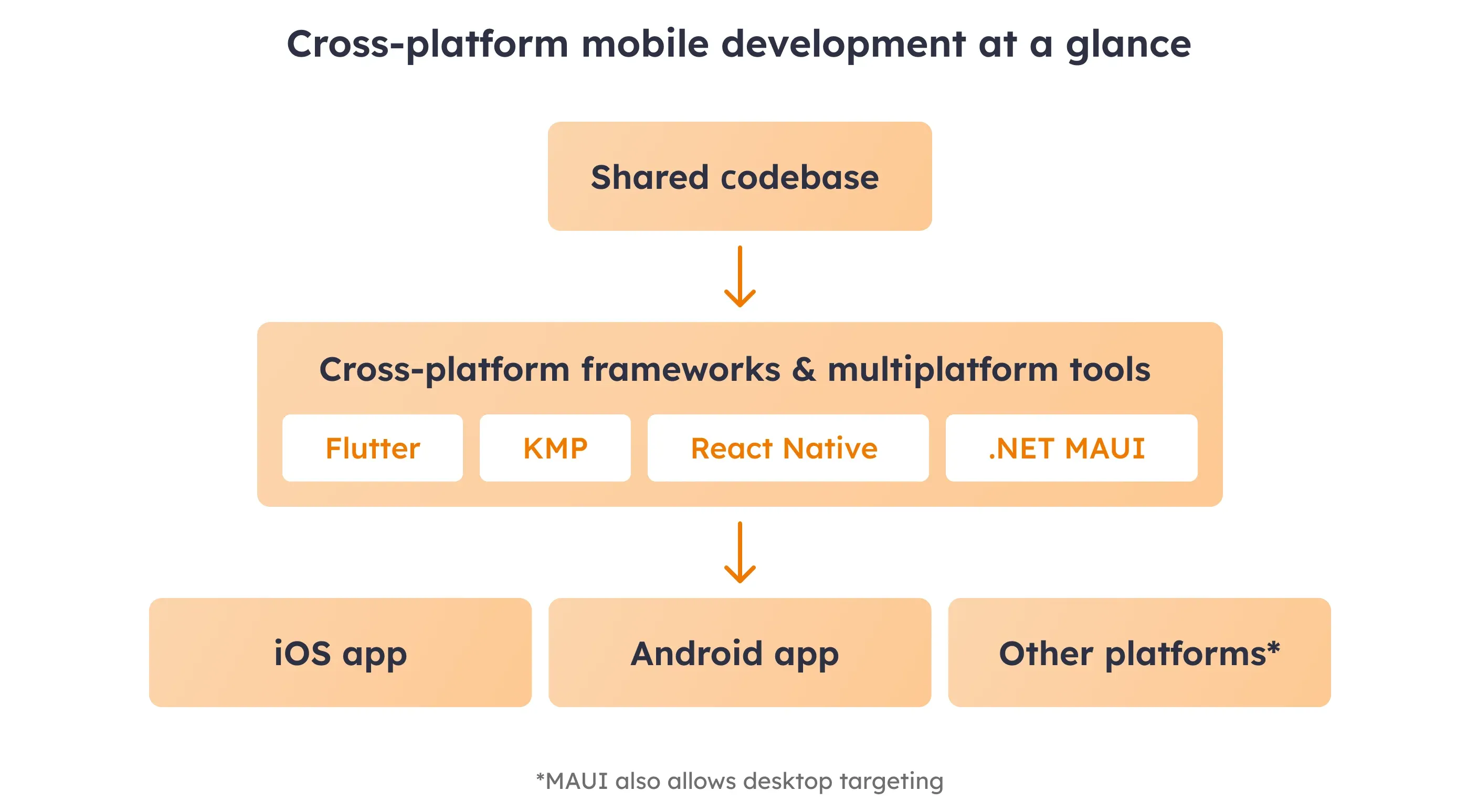
One shared core – and four major ways to bring your product to every device without losing its identity.
But “one codebase” is only the visible part. What actually defines cross-platform mobile apps development today is the maturity of the frameworks behind it. I see it daily in my practice, and it’s good to see recent research making this shift visible beyond the engineering trenches. Lin’s 2025 review shows that unified architectures can reduce development time and improve maintainability, while Saxena et al. (2024) demonstrate how modern frameworks handle UI, logic, and platform capabilities with increasing consistency. In other words, cross-platform is no longer a workaround for simple apps – it’s a structured, well-supported ecosystem suitable for products with real complexity.
For businesses, understanding what cross-platform mobile development is means understanding its implications: faster synchronized releases, a more coherent product across devices, and a technology stack that can adapt as the product grows. For developers, it means working with tools that let them focus on building features instead of re-implementing them twice. And for both sides, it’s a reminder that choosing cross-platform isn’t about chasing trends – it’s about choosing the most effective way to deliver value to users across different platforms.
When cross-platform solutions for mobile app development work
Cross-platform mobile development isn’t universal. It works exceptionally well in some scenarios and becomes a liability in others. Understanding this difference early prevents teams from fighting the wrong battles – or investing in an approach that won’t support the product’s trajectory.
It works when the product needs the same updates, delivered quickly and consistently
Cross-platform shines when both platforms need to evolve together – same features, same timing, same experience. In my work, unified codebases reduce drift far more reliably than separate native tracks. It’s encouraging to see recent research, including Lin’s (2025), describing maintainability as a long-term structural benefit rather than a budgeting trick.
The approach also fits well when the product roadmap is dynamic. If the business expects rapid iterations, experiments, or market-driven pivots, having one foundation instead of two can dramatically simplify how teams respond to change.
It struggles when the product depends heavily on deep native capabilities
Some products are defined by what’s happening at the very edge of platform capabilities – advanced animations, platform-specific interactions, low-level APIs, or performance-critical experiences. It is clear that native approaches still outperform cross-platform tools in areas requiring tight integration with platform internals. If your product relies on this kind of depth, a native approach may give more freedom and fewer constraints.
It becomes risky when the organization isn’t aligned
Finally, cross-platform isn’t just a technical solution – it’s an organizational one. If the business expects platform-level differentiation, or if teams operate in separate silos with different priorities, a shared codebase can create friction instead of reducing it. And if engineers can’t translate technical implications into business language, decisions tend to be made blindfolded – and that usually shows up later as missed deadlines or inconsistent UX.
As you can see, mobile cross-platform app development works when it supports the product’s direction – speed, parity, adaptability – and breaks down when the product’s demands exceed its structural advantages.
The goal isn’t to choose the “better” option. It’s to choose the one that aligns with how the product needs to grow.

Pick the approach that fits your product’s direction – not the most popular framework
Modern cross-platform frameworks: what’s actually used today
Cross-platform development isn’t one technology – it’s a family of approaches. And choosing between them isn’t about preference, but about how well a specific tool matches the product’s needs, the team’s structure, and the expected level of platform integration. In 2025, four frameworks dominate the practical landscape, each with its own strengths and trade-offs.
Flutter: unified UI, high consistency
Flutter offers one of the most cohesive environments in cross-platform mobile app development. With its own rendering engine and expressive UI toolkit, it delivers near-identical behavior across devices.
How it works | How it helps the product |
|---|---|
Flutter doesn’t rely on native UI components. Every pixel on the screen is drawn by Flutter’s rendering engine, layered over the platform surface, which ensures predictable behavior, smooth animations, and strong consistency across platforms. | A strong choice when unified UI, synchronized releases, and visual consistency are top priorities. |
React Native: shared logic inside a familiar ecosystem
React Native connects JavaScript/TypeScript expertise with mobile delivery. It’s a natural fit for teams with a strong frontend background, allowing them to move quickly while leveraging familiar tooling.
How it works | How it helps the product |
|---|---|
Business logic runs in JavaScript, while the app renders native iOS and Android components. Communication between the two layers happens through the JS bridge, which can affect performance in complex scenarios. | Fast iteration, broad ecosystem, and access to native UI – ideal for products that evolve quickly and require tight integration with web technologies. |
Kotlin Multiplatform: shared logic, native experience
KMP approaches cross-platform mobile development from the opposite angle: instead of unifying the UI, it unifies business logic. The interfaces remain fully native – SwiftUI for iOS and Jetpack Compose for Android.
How it works | How it helps the product |
|---|---|
It creates a shared Kotlin module for domain logic, which is then consumed by two native applications. This results in fully native user experiences without duplicating complex logic. | A strong fit for long-lived, feature-rich products where architecture, maintainability, and platform-specific UX matter. |
.NET MAUI: multi-platform architecture for enterprise environments
MAUI extends beyond mobile, offering a unified .NET ecosystem that spans iOS, Android, Windows, and macOS. This makes it particularly relevant for enterprise environments where mobile apps are part of a broader platform.
How it works | How it helps the product |
|---|---|
MAUI uses a shared .NET layer and XAML-based UI, with platform-specific renderers handling the visual output. It aligns mobile and desktop development under a single architecture. | Ideal for products that must live across multiple device types and for teams already invested in the .NET stack. |
Summary: is cross-platform mobile development worth it in 2026?
By 2026, cross-platform mobile development is less about picking a framework and more about choosing how your product will evolve. The strongest teams treat cross-platform mobile app development not as a shortcut, but as a structural decision: one that shapes how quickly they can adapt, how consistently they can deliver, and how much complexity they’re willing to carry long-term.
When a product depends on alignment across platforms and the ability to adjust without doubling the work, a unified foundation can support that trajectory better than two separate stacks. When differentiation relies on deep native capabilities or platform-specific identity, the native path still sets fewer limits. The real distinction in 2026 isn’t between “native” and “cross-platform” – it’s between choices made with context and choices made by habit.
So yes, cross-platform is worth it – when it reinforces the direction your product is already moving, not when it tries to define it for you. And if you’re navigating that decision now, or weighing how it fits into your roadmap or your team’s capabilities, I’m always open to discussing the nuances. Sometimes a short conversation helps bring the picture into focus.
References & further reading
1.
Joshi, D. (2022). Building Cross-Platform Apps with Flutter and Dart. Helion.
2.
Jošt, A., & Taneski, V. (2025). State-of-the-Art Cross-Platform Mobile Application Development Frameworks: A Comparative Study of Market and Developer Trends. MDPI Information.
3.
Lin, J. (2025). Cross-Platform Mobile App Development: A Comprehensive Review of Current Approaches and Frameworks. University of Amsterdam.
4.
Saxena, P., et al. (2024). Comprehensive Insights into Cross-Platform Mobile Development. ACM Digital Library.
5.
Mounir, M. (2023). Software Engineering for Mobile Applications: A Survey on Challenges and Solutions. arXiv preprint.
6.
Jain, R. (2025). Scalable Frameworks for Cross-Platform Mobile App Development. Journal of Emerging Technologies and Innovative Research (JETIR).

Get a weekly dose of first-hand tech insights delivered directly to your inbox